A copy of a pamphlet titled ‘Irish councils for freedom’ ([Dublin, Sinn Féin, c.1920]).
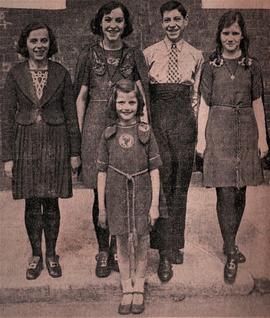
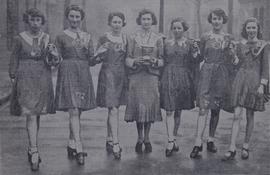
An image of Irish dancing prizewinners at the Father Mathew Feis in Dublin in 1938.
An image captioned as follows 'Pupils of the Mullholland School of Dancing, Belfast, who won the St. Michael's Cup for Hornpipe (under 16) at the Father Mathew Feis, Dublin'. The clipping was taken from the 'Irish Press'.
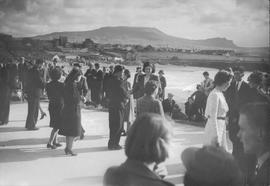
A view of traditional Irish dancing on the seafront at Bundoran, County Donegal, in about 1950.
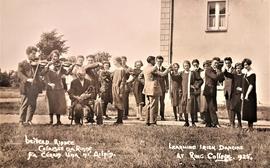
A photographic postcard print captioned ‘Learning Irish Dancing at Ring College’ (Coláiste na Rinne) in County Waterford. Coláiste na Rinne was established in 1905 and officially recognised as an Irish language summer school in 1907. The principal founders of the college were Pádraig Ó Cadhla (1875-1948), an organiser for Conradh na Gaeilge in the locality, and Richard Henebry (1863-1916), also known as Risteard de Hindeberg, a Waterford-born priest, Irish language scholar and traditional music collector.
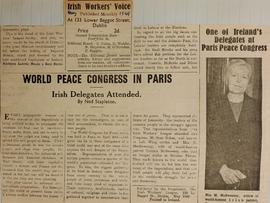
A clipping of an article by Ned Stapleton referring to the attendance of Seán Nolan and Muriel MacSwiney as Irish delegates at the World Peace Congress in Paris. The clipping is taken from the ‘Irish Workers’ Voice’ (May 1949).
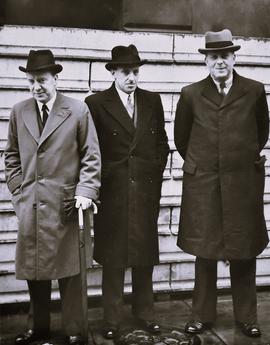
A photograph of the Irish delegation in London for negotiations with British officials. The group are from left to right John Whelan Dulanty, Irish High Commissioner, Seán Lemass, and Dr James Ryan.
James Hack Tuck, ‘Irish distress and its remedies / the land question / a visit to Donegal and Connaught in the spring of 1880’ (London: W. Ridgeway, 179 Piccadilly, 1880). The copy is incomplete and contains only the title page, preface, and pp 1-2 of the text.
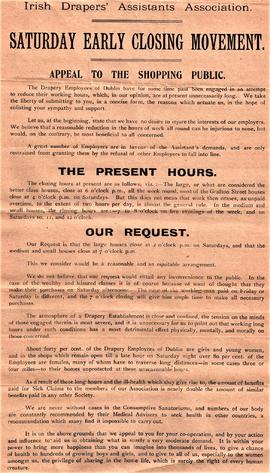
A flier from the Irish Drapers’ Assistants Association (IDAA) dated March 1906. The IDAA was founded by Michael O’Lehane (1873-1920), a Cork-born trade unionist. Unlike the more traditional trade unions O’Lehane was prepared to recruit women members. Out of a total effective membership of 4,000 in 1914, 1,400 IDAA members were women. It is noted in the flier that 40% of drapery employees in Dublin were female. The main objective of the IDAA was a reduction in the working hours per week. Reference is also made in the leaflet to the unhealthy working conditions endured by drapery employees and the risk particularly from tuberculosis.
A copy of the ‘Irish Ecclesiastical Record’, Vol. LXXII, No. 5 (November 1949). Printed by Browne & Nolan Limited in Dublin.