
The 'Irish Bulletin' was the official daily gazette of the government of the Irish Republic. The first edition of the 'Bulletin' appeared on 11 Nov. 1919 shortly after the suppression of the entire republican press. The purpose of the 'Bulletin' was succinctly stated in the edition of 11 Nov. 1920 (Vol. 6 No. 17). ‘When it became certain that the majority party in Ireland was not to be proclaimed “illegal” the "Bulletin" had of necessity to be published secretly. It was designed to circulate principally not in Ireland but among the publicists in England and on the Continent. At its inception less than fifty copies were printed. To-day it reaches almost every country in the world and is reprinted in four European languages. It is received by the press, public men, and the leading political and other organisations of many nations’. The 'Bulletin' was published daily but weekly editions containing summaries of ‘acts of aggression committed in Ireland by the military and police of the usurping English government’ were also routinely circulated. These weekly summaries were not assigned volume or issue numbers. Daily issues consisted mainly of sometimes detailed lists of raids by British security forces and the arrests of republican suspects. Extracts from foreign publications and sometimes sympathetic English sources were also published in the 'Bulletin'. Accounts of the activities of Dáil Courts were likewise included. It was produced by the republican publicity department during the War of Independence, and its offices were located at 6 Harcourt Street, Dublin. On 26 Mar. 1921, after sixteen months of publication, the offices of the 'Bulletin' were raided. Later, forged issues of the journal were produced with printing machinery and paper captured in the offices. These fabricated issues were sent to all the usual addresses on the list of recipients, a copy of which had also been seized. Issues of these forged 'Bulletins' were subsequently circulated for over a month. The paper’s first editor was Desmond Fitzgerald, until his arrest and replacement by Robert Erskine Childers. The collection includes a chronological record of peace overtures which would eventually lead to the Treaty negotiations. The issue of 7 Dec. 1921 (Vol. 6, No. 35) carried an ‘advance copy’ of the articles of agreement between Great Britain and Ireland, more commonly known as ‘The Treaty’. Many of the issues of the 'Irish Bulletin' are stamped ‘Official Copy’.
The file contains volume 4, 3 Jan. 1921 (No. 1)-31 May 1921 (No. 100) of the 'Irish Bulletin'. The series is complete with multiple copies of some issues.
Two VHS tapes with recordings of the 'Brothers in Mission' documentary on the work of the Irish Capuchin missionary friars in Africa. One of the tapes is annotated ‘Master Copy with no commentary’.
‘Beta Komos Photographics Limited, Letchworth, England’ box. The box is annotated: ‘Negatives. Irish Friars. Fr. Angelus Healy OFM Cap.’. The box includes twenty-two plates. The plates include:
(a) A family portrait of six unidentified individuals. The plate is contained within an envelope with has manuscript annotation of dates and places from c.1915-27.
(b) Br. Elzear Kelly OFM Cap. (1857-1937). With cover annotation.
(c) Fr. Peter Bowe OFM Cap. (1856-1926) sitting in front of ornamental rug. Two plates within an annotated envelope.
(d) A view of two Capuchin friars in the garden of St. Mary of the Angels, Church Street. One of the friars is cutting the lawn grass. With cover annotation.
(e) Interior view of Rochestown Friary Church. With cover annotation.
(f) Portrait of ‘the late John Bowe, Kilkenny Friary’. With cover annotation.
The plates marked g-u do not contain any annotations. They are views of unidentified Capuchin friars (either as individuals or in groups). Includes some views of friars in the interior of houses, playing hurling or outdoors such as on a horse and cart.
A bound volume containing photographic prints, mostly of Irish Capuchin friars including missionaries in both America and in Africa. For the most part, the photographs are uncaptioned. The album was assembled by Fr. Senan Moynihan OFM Cap. A manuscript annotation on the spine reads ‘Caps’.
The album includes the following prints:
Photograph of a group of Capuchin friars with Fr. Virgilio de Valstagna OFM Cap., Minister General. The group includes Fr. Edwin Fitzgibbon OFM Cap., Fr. Columbus Murphy OFM Cap., Fr. Augustine Hayden OFM Cap., Fr. Malachy Hynes OFM Cap., Fr. Paschal Larkin OFM Cap., Fr. Sylvester Mulligan OFM Cap. and several novices.
Photograph of a procession of Capuchin friars in an unidentified American city.
Photograph of Fr. Timothy Phelim O’Shea OFM Cap.
Photograph of Fr. Senan Moynihan OFM Cap., Fr. Colman Griffin OFM Cap. and another unidentified friar in a garden.
Photograph of Fr. Virgilio de Valstagna OFM Cap., Minister General, with Éamon de Valera. The photograph also includes Monsignor Killian Flynn OFM Cap., Vicar-Apostolic of Livingstone, Fr. Edwin Fitzgibbon OFM Cap., Provincial Minister, Archbishop Sylvester Mulligan OFM Cap., and Fr. Senan Moynihan OFM Cap.
Photograph of a large group of Capuchin friars possibly in Rochestown Friary, County Cork. The group includes Fr. Sylvester Mulligan OFM Cap., Br. Felix Harte OFM Cap., Fr. Senan Moynihan OFM Cap., Fr Colman Griffin OFM Cap., Fr. Martin Hyland OFM Cap. and Fr. Timothy Phelim O’Shea OFM Cap.
Studio photograph of Fr. Paschal Larkin OFM Cap.
Studio photograph of Fr. Henry Anglin OFM Cap.
Photograph of an unidentified friar praying at the High Altar, possibly in the oratory of the Capuchin College in Rochestown, County Cork. (This Italian-made wooden reredos is now located in Holy Trinity Church in Cork.)
Photograph of Fr. Paul Neary OFM Cap. and Fr. Fidelis Neary OFM Cap. and another friar in the garden of the Church Street Friary in Dublin.
Photograph of an unidentified Capuchin friar in Mission Santa Inés near Solvang in California.
Photograph of Br. Stanislaus Walsh OFM Cap. (1842-1910), Br. Felix Harte OFM Cap. (d. 11 Jan. 1935), Br. Elzear Kelly OFM Cap. (d. 11 Mar. 1937) possibly in the garden of Holy Trinity Friary in Cork.
Photograph of the Killian Flynn OFM Cap., Vicar-Apostolic of Livingstone, blessing a building in Northern Rhodesia (now Zambia).
Photograph of Fr. Paul Neary OFM Cap., Fr. Edwin Fitzgibbon OFM Cap. and Fr. Charles Brophy OFM Cap.
Photograph of Fr. Alban Cullen OFM Cap. and an unidentified cleric possibly in South Africa.
Studio photograph of Fr. Joseph Fenlon OFM Cap.
Photograph of a group of Capuchin friars possibly at a Provincial Chapter in the Church Street Friary in Dublin. The group includes Fr. Edwin Fitzgibbon OFM Cap., Fr. Aloysius Travers OFM Cap., Fr. Stanislaus Kavanagh OFM Cap., Fr. James O’Mahony OFM Cap., and Fr. Colman Griffin OFM Cap., Fr. Malachy Hynes OFM Cap., Fr. Canice Bourke OFM Cap., Fr. Charles Brophy OFM Cap. and Fr. Bonaventure Murphy OFM Cap.
Photograph of Fr. Virgilio de Valstagna OFM Cap., Capuchin Minister General, with Fr. Sylvester Mulligan OFM Cap. and other friar possibly meeting the Lord Mayor of Cork.
Photograph of Br. Timothy Phelim O’Shea, Br. Killian Flynn OFM Cap., Fr. Colman Griffin OFM Cap., and other friars (probably novices) some of whom appear to be dressed for a theatrical performance.
Photograph of Br. Declan McFadden OFM Cap. with other friars dressed as military band members and posing with musical instruments. The photograph was taken at the Temperance Hall in Rochestown in County Cork.
Studio photograph of Fr. Fintan Roche OFM Cap. (1898-1953).
Photograph of Fr. Henry Anglin OFM Cap. dressed in graduation robes.
Photograph of Fr. Andrew Carew OFM Cap. (1902-1987) and three other friars possibly in Rome.
Photographs of Fr. Senan Moynihan OFM Cap. with other Capuchin friars.
Photograph of Fr. Maurice Dowd OFM Cap. (1904-1989).
Photograph of friars bailing hay in the grounds of Ard Mhuire Friary in County Donegal.
Photograph of Killian Flynn OFM Cap., Vicar-Apostolic of Livingstone.
Photograph of Capuchin friars possibly at a communion service for Native Americans in California.
Photograph of the community of Capuchin friars at St. Mary of the Angels, Church Street, Dublin. The group includes Fr. Camillus Killian OFM Cap., Fr. Charles Brophy OFM Cap., Fr. Aloysius Travers OFM Cap., Fr. John Butler OFM Cap., Fr. Bernardine Harvey OFM Cap., Cap., Br. Elzear Kelly OFM Cap., and Fr. Columbus Murphy OFM Cap.
Studio photograph of Fr. Senan Moynihan OFM Cap. with a contributor to ‘The Capuchin Annual’.
Photograph of two unidentified Capuchin friars standing in the garden of the Church Street Friary in Dublin.
Photograph of Fr. Senan Moynihan OFM Cap., Fr. Edward Walsh OFM Cap. (1881-1961) and another friar.
Photograph of Capuchin friars in Northern Rhodesia (Zambia) in 1936. The group includes, front row (from left to right), Fr. Phelim O’Shea OFM Cap., Monsignor Killian Flynn OFM Cap., Fr. Oliver O’Hanlon OFM Cap.; back row, Fr. Christopher Crowley OFM Cap., Fr. Seraphim Nesdale OFM Cap., Fr. Timothy Connery OFM Cap., Fr. Casimir Butler OFM Cap., Br. Alexius Paolucci OFM Cap. and Fr. Jarlath Gough OFM Cap.
Studio photograph of Fr. Augustine Hayden OFM Cap. (1870-1954).
Photograph of Fr. Aloysius Travers OFM Cap. with a young female communicant and a man holding a religious banner commemorating the 700th anniversary of the death of St. Francis of Assisi (1926).
Photograph of an unidentified Capuchin Friar possibly at the Capuchin stand at the Foreign Missionary Exhibition in Dublin during the Eucharistic Congress in Dublin in 1932.
Photograph of Fr. Angelus Healy OFM Cap. at the summit of Croagh Patrick, County Mayo.
Photographs of Fr. Casimir Butler OFM Cap., Fr. Killian Flynn OFM Cap., Fr. Fintan Roche OFM Cap., Fr. Timothy Phelim O’Shea OFM Cap., and Fr. Christopher Crowley OFM Cap. with native children and adults in Northern Rhodesia (now Zambia).
Photograph of Fr. Senan Moynihan OFM Cap. with an unidentified cleric.
Photograph of the Archbishop Paschal Robinson OFM (1870-1948), Apostolic Nuncio to Ireland, with a group of Capuchin friars in the Church Street Friary in Dublin. The group includes Fr. Augustine Hayden OFM Cap., Fr. Charles Brophy OFM Cap., Fr. Aloysius Travers OFM Cap., Fr. Senan Moynihan OFM Cap., Fr. Benedict Phelan OFM Cap., and Fr. Edward Walsh OFM Cap.
Studio photograph of Fr. Killian Flynn OFM Cap., Fr. Timothy Phelim O’Shea OFM Cap. and Fr. Seraphim Nesdale OFM Cap.
Photograph of Fr. Sebastian O’Brien OFM Cap. (1867-1931) in the garden of the Church Street Friary.
Photographs of the funeral service and burial of Fr. Sebastian O’Brien OFM Cap. at Glasnevin Cemetery in Dublin in 1931. Fr. Ignatius Collins OFM Cap. and Fr. Senan Moynihan OFM Cap. are at the graveside.
Photograph of a group of Capuchin friars dressed in Roman costumes presumably for a theatrical performance at Rochestown Temperance Hall in County Cork.
Photograph of Fr. John Butler OFM Cap. (1873-1950) and the Lord Mayor of Cork in a carriage in front of the Crawford Municipal School of Art.
Postcard print of a student hurling team at Rochestown Capuchin College in County Cork. The students wear a striped jersey emblazoned with ‘CFC’. The print is annotated in pen, ‘Up Rochestown’.
Photograph of a group of Capuchin friars dressed in costume presumably for a theatrical performance. The group includes Br. Declan McFadden OFM Cap., Br. Timothy Phelim O’Shea OFM Cap. and Br. Henry Anglin OFM Cap.
Photographs of Fr. Senan Moynihan OFM Cap. with unidentified clerics.
Photograph of a group of Capuchin friars on board a small steamship possibly off the Cork coast.
Photograph of a memorial statute to Cardinal Guglielmo Massaia OFM Cap. (1809-1889), an Italian Capuchin friar and celebrated missionary in Africa.
Photographs of Fr. Timothy Phelim O’Shea OFM Cap. and Fr. Declan McFadden OFM Cap. dressed in costumes presumably for theatrical performances.
Photograph of Fr. Declan McFadden OFM Cap.
Studio photograph of Fr. Senan Moynihan OFM Cap. with an unidentified individual.
Copy print of a portrait drawing of Fr. Senan Moynihan OFM Cap. by Seán O’Sullivan RHA.
Photographs of Fr. Jarlath Gough OFM Cap., Fr. Albert Bibby OFM Cap. and other Irish Capuchin friars in the United States in 1924.
Photograph of Fr. Albert Bibby OFM Cap., Fr. Joseph Fenlon OFM Cap. and another Capuchin friar at Mission Santa Inés in California in 1924.
Photographs of the funeral of Fr. Albert Bibby OFM Cap. (d. 14 Feb. 1925) at Mission Santa Inés in California in February 1925.
Photographs of Fr. Senan Moynihan OFM Cap.
Photograph of Fr. Senan Moynihan OFM Cap. and Éamon de Valera.
Photograph of Alfie Byrne, Lord Mayor of Dublin, and Fr. Edward Walsh OFM Cap. attending the opening of a children’s playground in Broadstone in Dublin.
Photograph of Fr. Michael O’Shea OFM Cap. (1892-1958) presenting ‘The Capuchin Annual’ Cup at the Feis Maitiú in Dublin.
Photograph of a confirmation class in Ukiah, California, in 1924.
Photograph of Fr. Senan Moynihan OFM Cap. and Éamon de Valera.
Photograph of the bust of Fr. Theobald Mathew OFM Cap. by John Hogan (1800-1856)
Studio photograph of Ignatius Persico OFM Cap., Archbishop of Damietta (1823-1896).
Photograph of Br. Killian Flynn OFM Cap. (1905-1972), possibly as a student in the Seraphic College in Rochestown in County Cork.
Photograph of Holy Trinity Church and Parliament Bridge in Cork.
Photograph of a large group of students at Rochestown Capuchin College in County Cork. Fr. Timothy Phelim O’Shea OFM Cap. and several other Capuchin friars are present.
Photograph of a student hurling team at Rochestown Capuchin College in County Cork. Fr. Bonaventure Murphy OFM Cap. is present in the photograph. The image is titled ‘A group of Young Irish Crusaders’.
A bound volume containing photographic prints, mostly of Irish Capuchin friars including missionaries in both the United States and in Africa. Many of the photographs are captioned. The album was seemingly assembled by Fr. Senan Moynihan OFM Cap.
The album includes the following prints:
Fr. Edwin Fitzgibbon OFM Cap.
Bishop Anastasius Hartmann OFM Cap.; Archbishop Ignatius Persico OFM Cap.
Fr. Sebastian O’Brien OFM Cap.
Fr. Anslem Griffin OFM Cap.; Fr. Cuthbert McCann OFM Cap.
Fr. Eugene Carroll OFM Cap.
Fr. Kevin Moynihan OFM Cap.; Fr. Angelus Healy OFM Cap.; Fr. Paul Neary OFM Cap. and Fr. Fidelis Neary OFM Cap. in 1930.
Fr. Jerome McQuillan OFM Cap.; Monsignor Killian Flynn OFM Cap.; Fr. Sylvester Mulligan OFM Cap.
Br. Leo Cronin OFM Cap.; Fr. Michael O’Shea OFM Cap., Fr. Mark McDonnell OFM Cap.
Fr. Cassian O’Shea OFM Cap.; Fr. Ignatius Collins OFM Cap.
Br. Alexius Paolucci OFM Cap.; Fr. Jarlath Gough OFM Cap.
Fr. Hilary McDonagh OFM Cap.; Fr. Christopher Crowley OFM Cap.
Fr. Timothy Connery OFM Cap.; Br. Bonaventure McCafferty OFM Cap.; Fr. Fintan Roche OFM Cap.
Exterior of the former Irish Capuchin Friary at Bar-sur-Aube in France in 1919.
Fr. Andrew Carew OFM Cap.; Fr. Philip King OFM Cap.
Fr. Aganthangelus Herlihy OFM Cap.
Fr. Timothy Phelim O’Shea OFM Cap.
Cardinal Guglielmo Massai OFM Cap.
Fr. Seraphim Bolger OFM Cap.; Fr. Maurice Dowd OFM Cap.
Fr. Alfred O’Mahony OFM Cap.; Fr. Timothy Phelim O’Shea OFM Cap.; Fr. Fergus Buckley OFM Cap.
Fr. Columban McGarry OFM Cap.; Fr. Cuthbert McCann OFM Cap.
Fr. Robert Rattigan OFM Cap.; Fr. Vivian O’Connell OFM Cap.; Fr. Pius Duggan OFM Cap.; Fr. Brendan Casey OFM Cap.
Fr. Nicholas Murphy OFM Cap.; Fr. Terence Anglin OFM Cap.
Fr. Eustace Burke OFM Cap.; Fr. Sebastian O’Brien OFM Cap.; Fr. Nicholas O’Brien OFM Cap.
Group photograph in the Church Street Friary in Dublin, including Fr. Daniel Patrick O’Reilly OFM Cap.; Fr. Columbus Maher OFM Cap., Fr. Francis Hayes OFM Cap., Fr. Nicholas Murphy OFM Cap.; Br. Leo Cronin OFM Cap., Br. Felix Harte OFM Cap., Fr. Salvator Corrigan OFM Cap., Fr. Benvenutus Guy OFM Cap., Br. Joseph Mahony OFM Cap.
Fr. Columbus Maher OFM Cap.
Exterior view of Holy Trinity Church, Cork (before the completion of the spire).
Former Irish Capuchin Friary in Charleville-Mézières in France.
Fr. Dominic O’Connor OFM Cap.
Group photograph of friars in Holy Trinity Friary in Cork, including Fr. Angelus Healy OFM Cap., Fr. Edwin Fitzgibbon OFM Cap., Fr. Albert Bibby OFM Cap. and Fr. Stanislaus Kavanagh OFM Cap.; Postcard print of the study hall in the Capuchin College in Rochestown in County Cork.
Thomas MacGreevy, Fr. Senan Moynihan OFM Cap., and Fr. Gerald McCann OFM Cap. on O'Connell Street in Dublin; Fr. Ignatius Collins OFM Cap.
Archbishop Anselm Edward John Kenealy OFM Cap.
Br. Leo Cronin OFM Cap.
Fr. Xavier Cox OFM Cap., Fr. Eustace Burke OFM Cap., Fr. Capistran Singleton OFM Cap., Fr. Andrew Carew OFM Cap., Fr. Terence Anglin OFM Cap., Fr. Fergus Buckley OFM Cap. captioned ‘bound for Africa, 1942’.
Br. Colmcille Cregan OFM Cap. with altar servers and Third Order of St. Francis members.
Fr. Charles, a French Capuchin friar with leprosy patients in Ethiopia in 1930.
Fr. Angelus Nangle OFM Cap. (with a manuscript signature).
Fr. Brendan O’Callaghan OFM Cap. with Catholic scouts; Fr. Felix Guihen OFM Cap., Fr. Colman Griffin OFM Cap., Archbishop Sylvester Mulligan OFM Cap., Fr. Columban McGarry OFM Cap., Fr. Cassian O’Shea OFM Cap., Fr. Andrew Carew OFM Cap. at Ard Mhuire Friary in County Donegal.
Fr. Senan Moynihan OFM Cap. and Fr. Gerald McCann OFM Cap.
Fr. Bernardine Harvey OFM Cap. and Fr. Brendan O’Callaghan OFM Cap.
Fr. Benedict Phelan OFM Cap., Fr. Bernardine Harvey OFM Cap., Fr. Brendan O’Callaghan OFM Cap. and Fr. Angelus Healy OFM Cap.
High Altar of St. Mary of the Angels, Church Street, Dublin; A Capuchin friar (possibly Br. Colmcille Cregan OFM Cap.) at the ruined Annaghdown Cathedral in County Galway.
Fr. Gerald McCann OFM Cap., with Catholic scouts on St. Patrick’s Day in 1945.
Fr. Henry Anglin OFM Cap.
Monsignor Killian Flynn OFM Cap.
Br. Colmcille Cregan OFM Cap; Fr. Raymond Dillane OFM Cap.; Fr. Brian Browne OFM Cap.
Fr. Xavier Riordan OFM Cap.; Fr. Bosco Lennon OFM Cap.
Interior of the Capuchin General Library in Rome.
Fr. Henry Anglin OFM Cap. and Fr. Justin Hyland OFM Cap.
Fr. Clement of Milwaukee OFM Cap., Minister General.
Fr. Virgilius Murtagh OFM Cap. and Fr. Henry Anglin OFM Cap. with female members of the choir of St. Mary of the Angels, Church Street, Dublin.
Group photograph of friars in the Church Street Friary garden including Fr. Gerald McCann OFM Cap., Fr. Virgilius Murtagh OFM Cap., Fr. Senan Moynihan OFM Cap. and Fr. Henry Anglin OFM Cap.
Work on the sculpture of Fr. Stephen Eckert OFM Cap., an American Capuchin Friar noted for his ministry to African Americans.
Bishop Timothy Phelim O’Shea OFM Cap. with communicants.
Capuchin Friary, Santa Casa, and the Loreto complex in Prague, Czechoslovakia.
Scenes of Capuchin novices performing a play in Rochestown Friary in County Cork.
Fr. Bosco Lennon OFM Cap.; Fr. Aganthangelus Herlihy OFM Cap.
Bishop Timothy Phelim O’Shea.
Sanctuary of Madonna del Sasso, Locarno, Switzerland.
Fr. Flannan Downing OFM Cap., Bishop Timothy Phelim O’Shea OFM Cap. and relations along with Fr. Maurice Dowd OFM Cap., and Fr. Henry Anglin OFM Cap in Rome in 1950.
Fr. Conrad O’Donovan OFM Cap.
Fr. Alexander Hannigan OFM Cap., Fr. Conor Brady OFM Cap., Fr. Clement of Milwaukee OFM Cap. (Minister General), and Fr. Cuthbert Gumbinger, secretary to Fr. Clement.
The file comprises ten plates and includes images of both individual Irish Capuchin friars and scenery and locations.
35 (a) A view of St. Mary of the Angels, Church Street, Dublin, from a slightly elevated position. The print shows the building before the addition of the Sacred Heart Chapel which was built as an aisle church in 1908. The caption refers to the ordination of Fr. Theobald Mathew OSFC (1790-1856) in the previous chapel on Church Street in 1809. With cover. A copy of this image is extant at CA-PH-1-71.
35 (b) Two plates of Fr. Berchmans Cantillon OFM Cap. (1880-1942). With cover.
35 (c) Two Capuchin friars and two dogs in the Church Street Friary garden. With annotated envelope suggesting that this is likely a poor quality image.
35 (d) Fr. Alphonsus Carroll OFM Cap. (1874-1934). With cover.
35 (e) Fr. Salvator Maria Corrigan OFM Cap. (1835-1919). The annotation on the cover suggests that this may be a poor quality image.
35 (f) An unidentified family group (six standing and five sitting or kneeling).
35 (g) Two plates of two separate and unidentified women. The annotated cover suggests that they are ‘Jenny & May’.
35 (h) An unidentified church and graveyard.
A bound volume containing photographic prints, mostly of Irish Capuchin friars including missionaries in the United States and in Africa. The volume also includes numerous images of Capuchin houses in Ireland and missionary postcards showing Capuchins (of varying nationalities) ministering in Africa and in India. The volume was probably compiled by Fr. Senan Moynihan OFM Cap. Some of the prints have later manuscript annotations.
The album includes the following prints (the numbers refer to the page reference in the volume):
- Patrick Collier, Bishop of Ossory, with Fr. Bonaventure Murphy OFM Cap., Fr. Ignatius Collins OFM Cap. and Fr. Colman Griffin OFM Cap. at the Church of St. Francis in Kilkenny.
- A Capuchin Friar and another individual at the front entrance to Ards House (Ard Mhuire, Capuchin Friary) in County Donegal.
- Fr. Senan Moynihan OFM Cap. standing beside a biplane.
- A Capuchin friar ascends a staircase possibly in Ard Mhuire Friary in County Donegal.
- A group of Capuchin Friars (possibly novices and including Br. Timothy Phelim O’Shea and Br. Declan McFadden OFM Cap.) dressed for a theatrical performance.
- A view of the Church and adjoining Capuchin Friary at Rochestown in County Cork.
- A view of the exterior of the Church of St. Francis and adjoining Capuchin Friary on Walkin (now Friary) Street in Kilkenny.
- Fr. Colman Griffin OFM Cap. and Fr. Charles Brophy OFM Cap. at a funeral mass at St. Mary of the Angels Church in Dublin.
- Studio photograph of Fr. Mark McDonnell OFM Cap. and an unidentified Capuchin friar with missionary crosses.
- Fr. Colman Griffin OFM Cap. conducting the funeral service of Fr. Edwin Fitzgibbon OFM Cap., former Provincial Minister, at the cemetery of Rochestown Friary, County Cork. Many Capuchin friars are in attendance.
- An aerial view of the Capuchin Friary on Church Street in Dublin. Includes extensive views of the garden fronting onto Bow Street.
- Fr. Senan Moynihan OFM Cap. with an unidentified cleric and a lay person.
- Fr. Thomas Dowling OFM Cap. with a group of schoolchildren probably in the United States.
- The altar containing the shrine of Saint Conrad of Parzham OFM Cap. at the Friary Church, Altötting, Bavaria, Germany.
- Sylvester Mulligan OFM Cap., Archbishop of Delhi Simla, with other Capuchin bishops and missionary clerics.
- An aerial view of the Capuchin Friary on Church Street in Dublin.
- The installation of Fr. Killian Flynn OFM Cap. as Prefect Apostolic of Victoria Falls in Northern Rhodesia in 1936.
- Fr. Luke Sheehan OFM Cap., Fr. Cassian O’Shea OFM Cap., and Fr. Leo Sheehan OFM Cap. in Rome in 1925.
- Fr. Pete Bowe OFM Cap., Provincial Minister, with other clerics probably during a visitation to the United States.
- A group of Capuchin friars including Fr. Fiacre Brophy OFM Cap., Fr. Peter Bowe OFM Cap., Fr. Sylvester Mulligan OFM Cap. and Fr. Martin Hyland OFM Cap. with Daniel Cohalan, Bishop of Cork, on ordination day in Holy Trinity Church in Cork. 29 June 1923.
- A group of student hurlers probably at Rochestown College, Cork.
- The arrival of the remains of Fr. Albert Bibby OFM Cap. for burial at Mission Santa Inés in California. February 1925.
- Fr. Peter Bowe OFM Cap. addressing a large crowd at the opening of Father Mathew Park, Fairview, Dublin, in 1908.
- Fr. Senan Moynihan OFM Cap. and an unidentified woman in Port Said, Egypt, on 1 September 1933.
- A group of Capuchin friars at the Provincial Chapter in the Church Street Friary, Dublin, in 1922.
- Fr. John Butler OFM Cap. in the uniform of a British military chaplain.
- Fr. Berchmans Cantillon OFM Cap. and an unidentified Capuchin friar wearing a missionary cross.
- Fr. Camillus Killian OFM Cap. with an unidentified Franciscan Friar in the Church Street Friary garden.
- Fr. Bernardine Harvey OFM Cap. standing on steps.
- Fr. Virgilio de Valstagna OFM Cap., Capuchin Minister General, giving blessings to individuals outside St. Bonaventure’s Friary in Cork.
- Fr. Casimir Butler OFM Cap. and other unidentified Capuchin friars possibly at St. Bonaventure’s Friary in Cork.
- The exterior of the Capuchin Friary, Frascati, Rome.
- Fr. Paul Neary OFM Cap. and his half-brother Fr. Fidelis Neary OFM Cap. in the garden of the Church Street Friary in Dublin.
- The garden of the Capuchin Friary on Church Street in Dublin.
- Fr. Senan Moynihan OFM Cap. and an unidentified individual on a beach.
- Pilgrims rowing to the Sanctuary of St. Patrick, Lough Derg, County Donegal.
- The exterior of Father Mathew Hall on Church Street in Dublin.
- Capuchin friars in the garden of the Church Street Friary observe the building of a chimney at Jameson’s Distillery in Smithfield, Dublin.
- Fr. Gabriel Harrington OFM Cap., Fr. Adrian Sharkett OFM Cap., Fr. Camillus Killian OFM Cap., Br. Francis Treacy OFM Cap., Fr. Bernardine Harvey OFM Cap.
- Capuchin novices including Br. Albert Bibby OFM Cap., Br. Columbus Murphy OFM Cap., Br. Sebastian O’Brien OFM Cap., Br. Aloysius Traves OFM Cap., Br. Stanislaus Walsh OFM Cap., Br. Thomas Dowling OFM Cap. and Br. Mark McDonnell OFM Cap.
- A large group of friars with musical instruments (violins, flutes, an accordion and banjo). The photograph was probably taken in Kilkenny.
- Fr. Chrysostom Sutton OFM Cap.
- A group of American Capuchin priests. Annotation on reverse reads: ‘seated, Fr. Agatho (grey beard) and Fr. Gabriel McCarthy OFM Cap. / top: Rudolf and Sylvester / made in China Tinchow, Kansu [Province of Gansu], May 1929’. The photograph shows the friars in traditional Chinese dress.
- Fr. Sylvester Mulligan OFM Cap. with four of his uncles and an aunt (all of whom are religious). One of the friars is presumably Fr. Anthony Brennan OFM Cap. of Tasson (d. 1928).
- Capuchin novices including Br. Ignatius Collins OFM Cap., Br. Columbus Murphy OFM Cap. and Br. Bonaventure Murphy OFM Cap.
- A group of Capuchin friars (including Fr. Ignatius Collins OFM Cap., Fr. Chrysostom Sutton OFM Cap. and Fr. Bonaventure Murphy OFM Cap.) at Whitegate, Cork.
- Studio photograph of Fr. Benignus Brennan OFM Cap. (d. 15 Apr. 1950).
- Studio photograph of Br. Didacus Kelleher OFM Cap. (d. 3 May 1947).
- Group of Capuchin friars at an ordination day on 29 September 1902. The group includes the Most Rev. Dr. Clarke OFM Cap., Fr. Kevin Moynihan OFM Cap., Fr. Casimir Butler OFM Cap., Fr. Francis Hayes OFM Cap., Fr. Peter Bowe OFM Cap., Fr. Finbarr O’Callaghan OFM Cap., Fr. Chrysostom Sutton OFM Cap., and Fr. Adrian Sharkett OFM Cap.
- Fr. Aganthangelus O’Herlihy OFM Cap., Fr. Christopher Crowley OFM Cap., and Br. Alexius Pauolucci OFM Cap. in Northern Rhodesia.
- Archbishop Sylvester Mulligan OFM Cap. and a religious sister and with what appears to be a leprosy patient in India.
- ‘In the land of the Bhils, Central India, Fr. Charles OFM Cap.’.
- A Capuchin friars treats leprosy patients in Abyssinia.
- Crypt at Santa Maria della Concezione dei Cappuccini in Rome.
- A Capuchin friar teaching mathematics to local school children possibly in Northern Rhodesia.
- The exterior of the Capuchin Church on Neuer Markt in Vienna, Austria.
- Cardinal Guglielmo Massaia OFM Cap. (1809-1889).
- Fr. Paul Neary OFM Cap. and his half-brother, Fr. Fidelis Neary OFM Cap. at the Marian Grotto in Rochestown, County Cork.
- Fr. Timothy Phelim O’Shea on a trek to out-schools in the bush of Northern Rhodesia.
- An Irish Capuchin friar observes work at mission station in Northern Rhodesia.
- Fr. Fintan Roche OFM Cap. and Fr. Timothy Phelim O’Shea OFM Cap. with an African family in Northern Rhodesia.
- The exterior of the Church of the Immaculate Conception in Parow, Cape Town, South Africa.
- Fr. James O’Mahony OFM Cap., Fr. Timothy Phelim O’Shea and another Capuchin friar at the statute of David Livingstone at Victoria Falls in Northern Rhodesia.
- Br. Alexius Pauolucci OFM Cap. in the savannah bush of Northern Rhodesia.
- A student Gaelic football team at Rochestown College in County Cork, in 1929.
- A procession of Third Order Brothers outside St. Mary of the Angels on Church Street in Dublin.
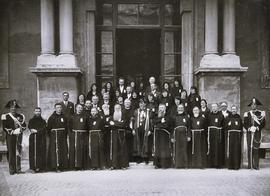
A photograph of a group of Irish Capuchin friars and pilgrims in Rome. The group includes Fr. Sylvester Mulligan OFM Cap, Fr. Hilary McDonagh OFM Cap., Fr. Stanislaus Kavanagh OFM Cap., Fr. Francis Hayes OFM Cap., and Fr. Eugene Carroll OFM Cap. The individual in the mayoral robes is Seán French, Lord Mayor of Cork. It is likely that the photograph was taken in May 1934 when an address from the citizens of Cork was presented to Pope Pius XI in honour of the papal holy year.
‘Barnet Red Seal Plate’ (Elliot & Sons, Ltd., Barnet, England) box. The box contains nineteen slides. None of the plates have annotations or captions and most of the descriptive content has been inferred. The box includes the following images:
(a) A junior football team. The ball is annotated with a date of 1908.
(b) Two images of Fr. Aloysius Travers OFM Cap. at a hurling match at Croke Park, Dublin, and at the head of a temperance procession.
(c) The hallway of Rochestown Capuchin Friary, County Cork.
(d) A group of Capuchin friars with musical instruments in the Kilkenny Friary in c.1905. The group includes Fr. Ignatius Collins OFM Cap. and Fr. Albert Bibby OFM Cap.
(e) A group of Capuchin friars in Kilkenny in about 1905. The title, ‘Conradh na Gaeilge’ (Gaelic League), has been superimposed on the original glass plate.
(f) Fr. Albert Bibby OFM Cap. with a group of students possibly at a hurling match in Rochestown, County Cork.