A copy of a pamphlet tilted ‘Free land or the three F’s by the Earl of Pembroke’ (London: W. Ridgeway, 169, Piccadilly, [1881]).
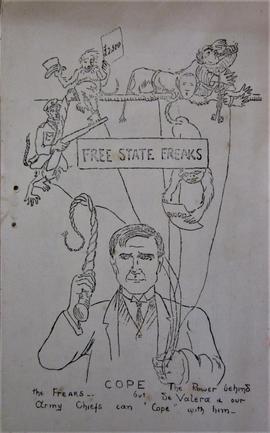
A one-off Anti-Treaty publication produced on a duplicating machine with caricatures of Sir Alfred Cope, Cosgrave, Mulcahy, Walsh, Blythe, Fitzgerald, etc. The drawings are attributed to Constance de Markievicz (1868-1927).
The publication includes caricatures of:
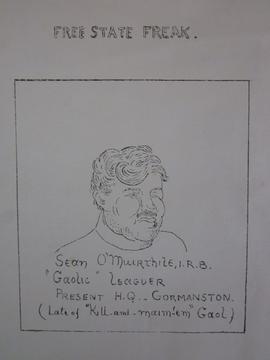
Séan Ó Muirthile, member of the Supreme Council of the IRB (Irish Republican Brotherhood) 1916, Head and shoulders.
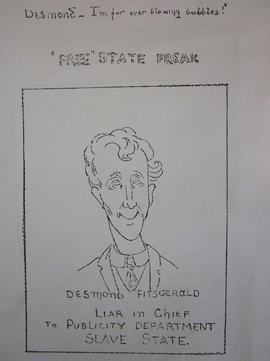
Desmond Fitzgerald, (1889-1947), Minister for External Affairs 1922-1927 and Minister for Propaganda outside the cabinet, August 1921. Described as ‘Liar in Chief to Publicity Department. Slave-State’. Head and shoulders, full face.
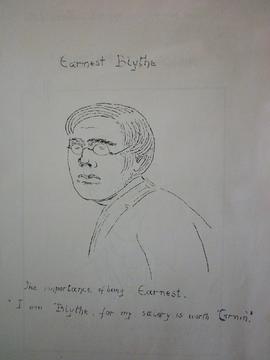
Ernest Blythe (1889-1975), Minister of Posts and Telegraphs: ‘The importance of being Earnest …’.
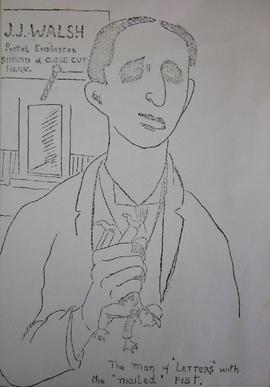
J.J. Walsh: ‘The man of “letters” with the “mailed” fist;
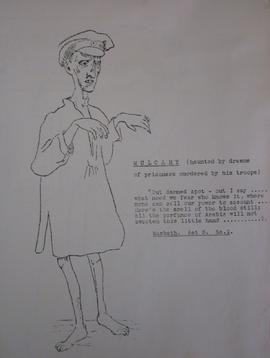
Richard Mulcahy: ‘haunted by the dreams of prisoners murdered by his troops’;
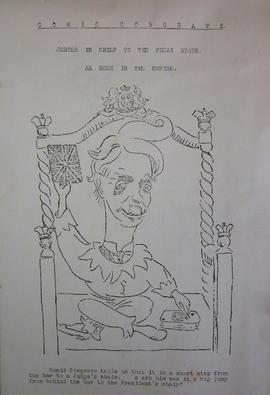
W.T. Cosgrave: ‘Jester in chief to the Freak State as seen in the Empire’.
An anti-Treaty cartoon referring to Desmond Fitzgerald (1889-1947), Minister for External Affairs (1922-7), and Minister for Propaganda outside the cabinet (August 1921). The caption refers to Fitzgerald as ‘Liar in Chief to Publicity Department. Slave-State’.
An anti-Treaty cartoon referring to Ernest Blythe (1889-1975), Minister of Posts and Telegraphs. The cartoon satirizes him by referring to ‘the importance of being Earnest …’.
An anti-Treaty cartoon referring to J.J. Walsh as ‘The man of “letters” with the “mailed” fist'.
An anti-Treaty cartoon referring to General Richard Mulcahy as ‘haunted by the dreams of prisoners murdered by his troops’.
An anti-Treaty cartoon satirizing Séan Ó Muirthile (1881-1941) as a member of the Supreme Council of the Irish Republican Brotherhood and commandant of Gormanston camp in County Meath.
An anti-Treaty cartoon referring to W.T. Cosgrave as the ‘Jester in chief to the Freak State'.
A pamphlet in the Anti-Treaty interest authored by the ‘Friends of Irish Freedom’ and published in New York. Reprinted from 'The Gaelic American', 28 Apr. 1923.
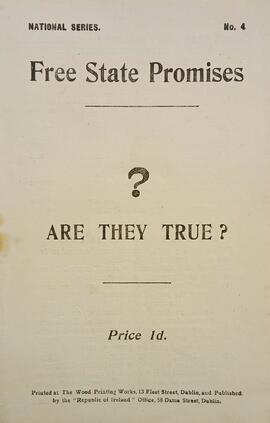
A copy of a pamphlet titled ‘Free State promises / are they true?’ (Dublin: printed at the Wood Printing Works, [c.1922]).