Showing 20640 results

Archival description
5754 results with digital objects Show results with digital objects
IE CA CP/3/3/3/2/4 · Part · 11 May 1914
Part of Capuchin Archives

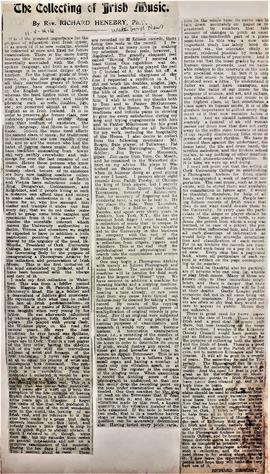
A clipping of an article by Fr. Richard Henebry titled ‘The Collecting of Irish music’ (‘Waterford News’, 11 May 1914). The article refers to Henebry's work on the preservation of traditional Irish tunes and to the need to establish an 'Phonogram Archive of Irish music' in University College Cork.
The Clogher Record
IE CA CP/1/13/5 · Item · c.1950-1955
Part of Capuchin Archives

Galley-copies of articles from 'The Clogher Record', the annual local history journal published by the Clogher Historical Society. The file includes Rev. B. O’Daly, ‘St. Macarten / first Bishop of Clogher and Patron of the Diocese’. With a cover noting that the galley prints are the property of the Very Rev. Monsignor Flood, Administrator, Diocese of Clogher.

IE CA CP/1/1/2/6/4 · Part · 1936
Part of Capuchin Archives

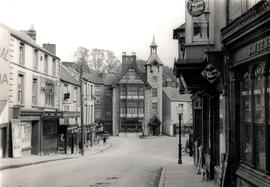
A view of the Clock House in Mallow, County Cork, in 1936. The photograph can be accurately dated due to the advertisement for the motion picture ‘Craig’s Life’ visible outside the Central Cinema to the left of the print. The film, starring Rosalind Russell and John Boles, was released in 1936. The Clock House was built around 1855, by Sir Charles Jephson-Norreys (1799-1888), a local MP and an amateur architect. His creation was said to be inspired by a trip he had undertaken to the Alps. The Clock was brought from the tower of the Old Mallow Castle. The bell was cast at Millerd Street in Cork. The bell tower became dangerous and was removed in about 1970, but was restored in 1995.

IE CA CS/5/2 · Subseries · 1912-1916
Part of Capuchin Archives

On the evening of 2 September 1913 two overcrowded tenement buildings at 66 and 67 Church Street collapsed. The two buildings were situated opposite the Capuchin Friary on the street. Of those trapped in the buildings, seven died (including three children) and many others were left seriously injured. Over 100 people were left homeless and destitute. The tragedy, occurring at a time of heightened political and labour unrest, highlighted the dreadful conditions of many of the buildings in Dublin, both in terms of the physical fabric of the dwellings and the endemic overcrowding in inner city tenements. A report on the disaster was presented to the British Parliament in February 1914, but with the outbreak of war in the summer of that year housing conditions in Irish capital ceased to be a political priority.

The Church at Sesheke
IE CA AMI/2/10/3/160 · Item · c.1969
Part of Capuchin Archives

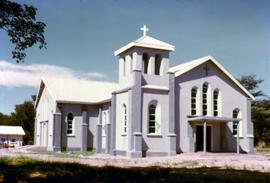
The exterior of the Church in Sesheke, Zambia (built by Fr. Capistran Singleton OFM Cap. in 1967).

The Christian Family
IE CA CP/3/17/11/9 · Part · 1920
Part of Capuchin Archives

Margaret Fletcher, ‘The Christian Family’ (Oxford: Catholic Social Guild, 1920). Published as part of the Catholic manuals for social students’ series.

IE CA HA/1/8/3/19 · Item · c.1977
Part of Capuchin Archives

Inscribed on the bowl: ‘The Charles Glendon Hearne Cup For Voice Production’. On reverse of the bowl: Names of winners from 1977-1977.

IE CA HA/1/8/3/24 · Item · c.1990
Part of Capuchin Archives

A trumpet, music sheet and laurel leaf motif is engraved on the bowl. The wooden base has a silver shield indicating that the cup was presented by the Loreto Nelson School of String Playing. With shields indicating the winners of the competition from 1990-97.